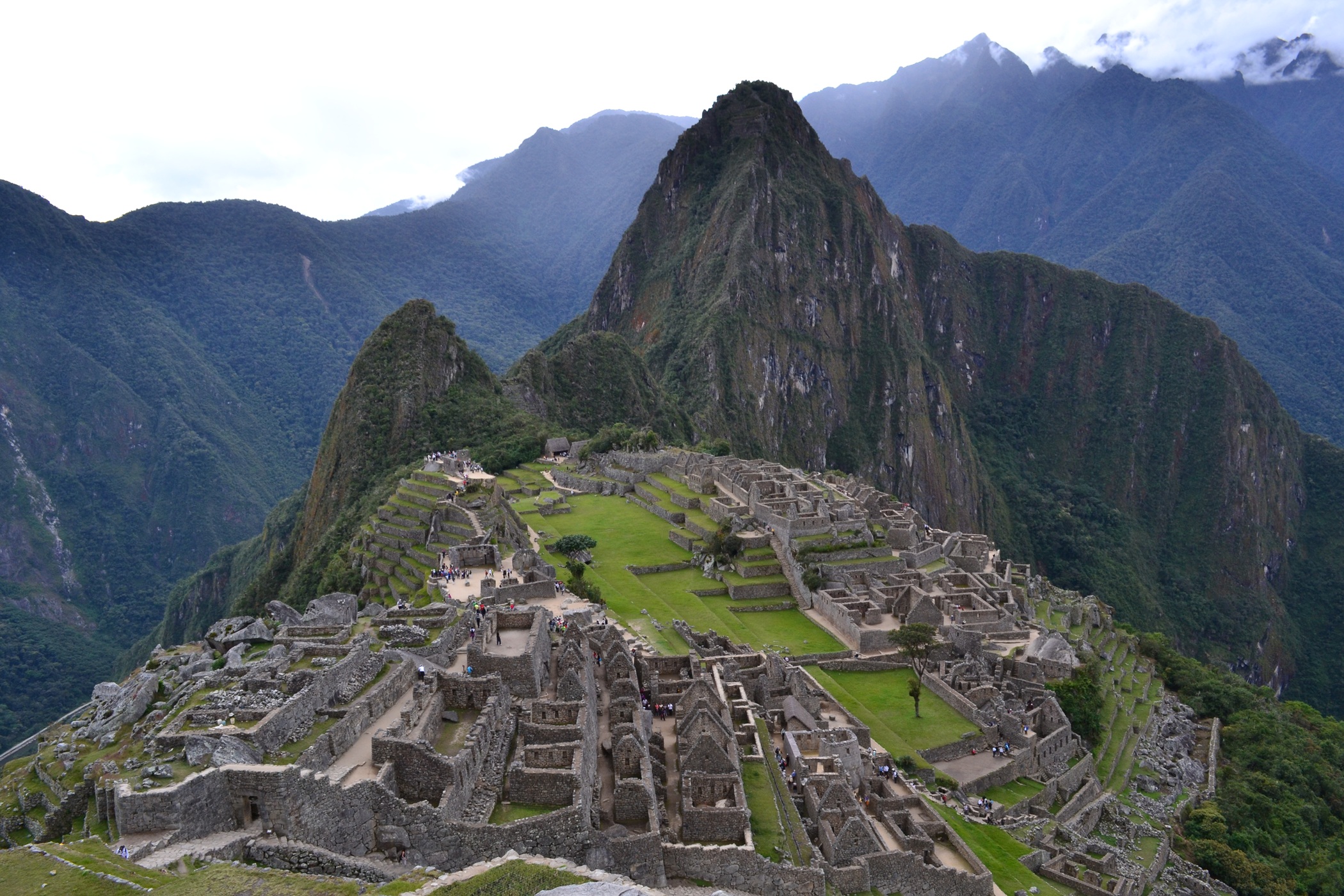
| Location: Machu Picchu, Peru Elevation: 7,970 feet Masonry: Stones precisely cut to fit tightly without mortar Culture: Inca civilization Built: 1450 |
Machu Picchu is a stunner. This legendary city on a ridge between two mountain peaks represents the apex of the Inca civilization. The two best ways to visit Machu Picchu are via the Vistadome train or the Inca Trail from Ollantaytambo. Take your pick, there’s no wrong answer. The Vistadome train offers full 360 views with giant glass windows from top to bottom and even in the roof. It’s a quick two-hour ride with panoramic vistas. The Inca Trail is a four-day expedition through ancient Inca footpaths across the Sacred Valley. The trek follows stone staircases by the Urubamba River and over Andes mountain passes.
The foliage is thick and dense with bromeliads, giant ferns, and cacti. From Aguas Calientes, it is a 45-minute bus ride up the hill to Machu Picchu. If I ever visit Machu Picchu again, I would spend two nights at Aguas Calientes. It would be great to have an entire day to explore Machu Picchu without rushing.
| Ancient Masonry | Ancient Royal Cribs | Sacred Spaces | Guard House | An Infinity Stone | Spanish Conquest |

Ancient Masonry
There is a shady path to the City Gate and the Incan Wall. The masonry is a feat of civil engineering. The Inca cut the stones so precisely, and without mortar. You can’t slip a piece of paper between the stones. Using a technique called ashlar, they used only bronze and stone tools to meticulously chisel and carve the granite blocks.

Ancient Royal Cribs
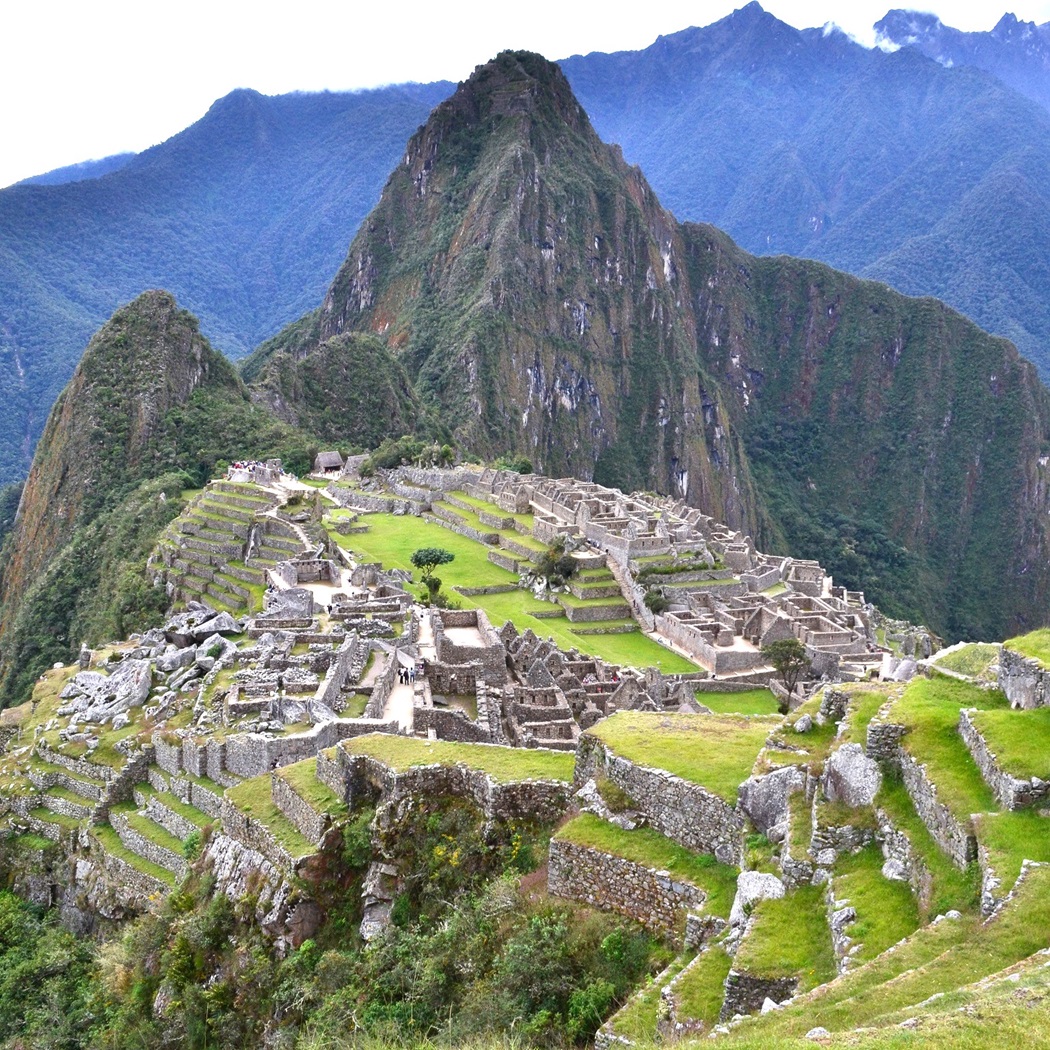
After you cross the City Gate, there are really step agricultural terraces. Llamas graze on the terrace lawns. From here, you can see the entire layout of the citadel with Huayna Picchu’s peak in the background. The royal residence is truly magical, maravilla, and misterioso.
The citadel has an Upper Town and Lower Town. The royal homes and temples were in the Upper Town. The workers and factories were in the Lower Town.
The Noble Houses are very spacious with indoor plumbing. Some bedrooms had a toilet inside. They houses are in rows above a slope. There are still fountains with running water that resemble waterfalls. The royals had walls with superior masonry.
Sacred Spaces
A staircase leads to the Temple of the Three Windows. The windows symbolized the Incan conception of three worlds: Hanan Pacha (heaven), Kay Pacha (earth), and Uku Pacha (underworld). The condor, puma, and snake represented the three worlds.

If you climb some more stairs, you arrive at the astronomical observatory. The Temple of the Sun is round and built on a massive monolith. During Winter Solstice, dawn’s first light rises above the mountains and shines through a window and onto the ceremonial stone. The Incas sacrificed llamas on the stone to Inti in hope of a good harvest. At the center of the city is the Main Square.

The large rectangular space has a green lawn. At the northern edge of the city is a giant ceremonial rock.

The Sacred Rock looks like the mountain behind it. It may have served as a portal to Huayna Picchu, the summit next to Machu Picchu. If you have time, climb to the peak of Huayna Picchu.


Guard House
If you return to the center of the city, there is a steep long staircase that leads to the Guardhouse. From this vantage point, you will receive a picture perfect, postcard view of Machu Picchu.


An Infinity Stone
The Intihuatana Stone aligns with the Sun during Winter Solstice. The Incas believed the Intihuatana tied the Sun to prevent it from going on forever and leaving them.

Spanish Conquest
The Spanish Conquest was extremely bad luck for the Incans. The Inca had been building for 500 years and was at a peak of 12 million people and 20 languages. This was a civilization just on the cusp of greatness. They put rebellious subjects to labor. Over 4,500 rebels had to haul immense stone blocks up and down narrow mountain paths. The Inca trails spanned 28,000 miles. They flattened hills and drained marshes. Food was plentiful and stored for years ahead. This is one of the most advanced ruins and a worthy member of the new Seven Wonders of the World. I wonder what the Incas could have accomplished if they had a little more time.


More World Wonders

Keep Exploring!
Africa | Antarctica | Asia | Australia | Europe | Middle East | North America | South America