
| Location: Chichen Itza, Yucatan, Mexico Height: 98 feet (Temple of Kukulcan) Levels: 9 square terraces, plus temple platform Steps: 91 steps on each side, plus platform, 365 total Materials: Limestone Built: 600-1000 (Maya civilization) |
The Maya controlled a vast network of semiautonomous cities across Mesoamerica that mysteriously declined one millennium ago. Their monumental cities stretched from the Yucatan Peninsula, Tikal in Guatemala, and as far as Nicaragua. The cities were lost to time and overgrown by rainforests. At Chichen Itza, you can view the incredible ruins especially the astronomically-oriented step pyramid – the Temple of Kukulcan. The peninsula also has other pyramids worth visiting at Uxmal, Coba, and Tulum.
| Mesoamerica | Chichen Itza | Great Ball Court | Temple of the Warriors | Platform of the Eagles and the Jaguars | Sacred Cenote | Temple of Kukulcan | Light Show | More about Cenotes | Uxmal |
Mesoamerica
Mesoamerica spans from central Mexico to northern Costa Rica. Indigenous civilizations prospered for 3,000 years before Spanish colonization. The Olmecs, Maya, Toltecs, and Aztecs harvested cacao, maize, beans, tomato, avocado, vanilla, squash, and chili. They engaged in pyramid building, human sacrifice, jaguar worship, calendar and astronomical research, and writing.
The Mayan empire flourished across Guatemala, Honduras, Belize, and Mexico from around 250 AD to 950 AD. After peaking in the 10th century, Chichen Itza declined after the 12th century for unknown reasons.
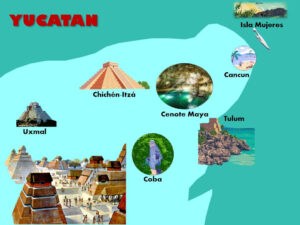
Chichen Itza (“At the edge of the well of the water”)
The Mayan city of Chichen Itza had inhabitants as early as 415 AD and rose to prominence around 600 AD. The Itza people fused older Mayan architectural styles with newer Toltec construction techniques. Chichen Itza is one of the Seven New Wonders of the World and a World Heritage Site.
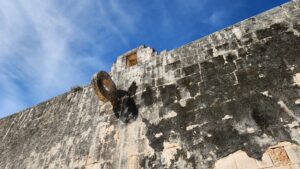
Great Ball Court
The rules of the ball game are simple. Get the rubber ball through the stone hoop on the side of the wall without using your hands or feet. First team to score wins. The game had a couple occasional scenarios involving human sacrifice. The first was a celebration of a victory over a rival city-state. The victors sacrificed the captives after playing a rigged game. In addition, the game was a religious ritual re-enacting the Mayan resurrection creation myth. Volunteers played for the honor of participating in the final moments of the ceremony. Winners earned a shortcut to the afterlife. Either way, the sacrifice was by decapitation or removal of the heart.
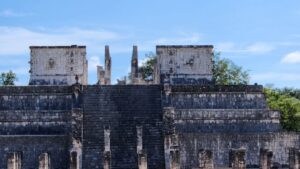
Temple of the Warriors
The temple is a 40-foot step pyramid with four platforms. There are 200 columns to the south and west. A central staircase leads to the top where there is a reclining Chac Mool statue. Chac Mool was associated with rain, war, and human sacrifice.
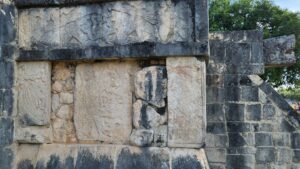
Platform of the Eagles and the Jaguars
The walls have stone bas-relief panels showing eagles and jaguars grasping human hearts in their claws. The eagles and jaguars symbolize warriors who capture victims to sacrifice to the sun god.
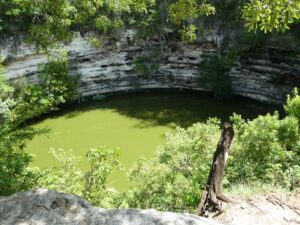
Sacred Cenote
At the Sacred Cenote, rulers performed human sacrifices for Chacmool (god of rain, lightning, and thunder) during times of drought.
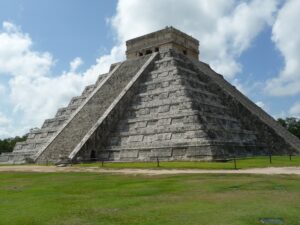
Temple of Kukulcan (El Castillo)
The Temple of Kukulcan is a four-sided step pyramid – 98 feet tall with 9 square terraces topped with a temple. Around the Equinoxes, the sun casts shadows that look like a giant serpent (Kukulcan) descending the steps. The serpent’s head is at the base. At certain spots, if you clap loudly enough, you can hear an imitation of a quetzal bird between the echoes.
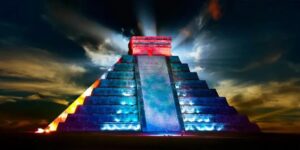
Light Show
There is a light and sound show most nights at the pyramid. The path to the show is dark, but on this night, there are lightning bugs to point the way. The show presents rain, lightning, and thunder. It is a celebration of the Mayan’s achievements in mathematics and astronomy. The climactic moment is when a snake climbs down the steps.
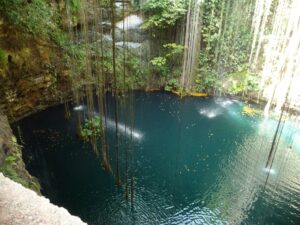
More about Cenotes
A giant asteroid struck Earth 66 million years ago, causing the mass extinction of the dinosaurs. It left a giant impact crater in the Yucatan Peninsula and the Caribbean Sea. On land, Chicxulub Crater’s rim contains brittle limestone, which resulted in over 6,000 sinkholes or cenotes. Mayans believed that cenotes were the gateway to Xibalba, the underworld. Cenotes were also important for their fresh water and use as ritual sites. People have found human remains, gold, and jade at the bottom. At night, jaguars drink the fresh water in the cenotes.
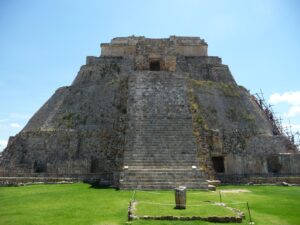
Uxmal
Uxmal still seems covered in vegetation. The Pyramid of the Magician is a step pyramid with an unusual elliptical base. It also has an interesting legend. A magical dwarf built the pyramid in one night as part of a challenge issued by the king of Uxmal. The best thing about Uxmal is that you can climb to the top of the pyramid.
More World Wonders

Keep Exploring!
Africa | Antarctica | Asia | Australia | Europe | Middle East | North America | South America